If you are moving abroad for work, study, or migration, foreign authorities will not accept your Bangladeshi certificates at face value. You need an e-Apostille to prove they are genuine. Many applicants still assume this means weeks of embassy attestation, because that used to be true. It is not anymore. Since Bangladesh joined the Apostille Convention, the entire process has moved online and now takes days rather than weeks. This guide walks through exactly which documents qualify, what the application looks like step by step, and what it actually costs.
What Is an e-Apostille
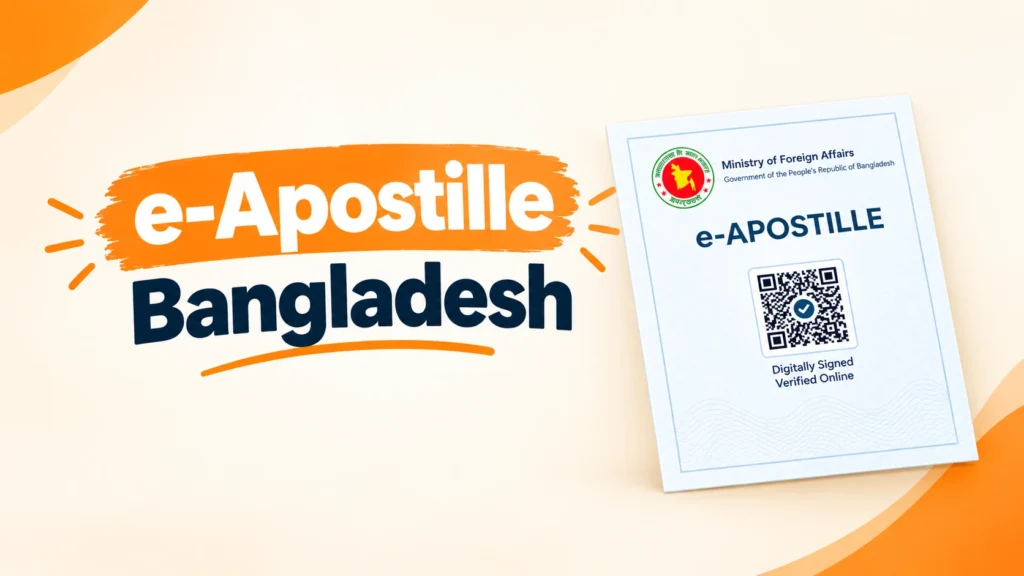
An e-Apostille is the digital version of the Apostille certificate, a single stamp of authenticity recognized across every member country of the Apostille Convention. Instead of a paper seal, it comes with a unique QR code and a digital signature that any foreign authority can verify online in seconds. In Bangladesh, the Ministry of Foreign Affairs (MOFA) is the body authorized to issue it, through the government’s myGov platform.
Bangladesh and the Apostille Convention: What Changed
For years, Bangladesh sat outside the Apostille Convention, which meant every document needed a long chain of manual attestation: notary, relevant ministry, MOFA, and then the destination country’s embassy in Dhaka. That changed when Bangladesh formally joined the Convention. Now, for any of the roughly 130 member countries, a single e-Apostille replaces that entire chain. If you have come across older articles or service pages claiming Bangladesh still is not a member, that information is out of date.
Apostille vs the Old Attestation Process
Old Attestation Process | e-Apostille Process |
Multiple stamps: notary, ministry, MOFA, embassy | One digital certificate from MOFA |
Often took weeks | Typically 3 to 7 working days |
Paper-based, easy to lose or damage | Digital, verifiable instantly via QR code |
Required for every destination country separately | Accepted across all Convention member countries |
Who Needs an e-Apostille
• Students applying to universities or colleges abroad
• Professionals accepting a job offer overseas
• Applicants going through marriage, immigration, or family reunification abroad
• Businesses sending commercial documents or powers of attorney to a foreign partner or branch
Documents Eligible for e-Apostille
Not every piece of paper qualifies on its own. Most documents need to be verified by the relevant ministry first, and some need notarization before they even reach that stage. Here is a breakdown by category:
Category | Examples | Verified By |
Personal | Birth, marriage, and death certificates; Police Clearance Certificates | Relevant civil authority or Home Affairs |
Educational | Degrees, transcripts, SSC/HSC certificates | Education Board, UGC, or Ministry of Education |
Legal & Commercial | Affidavits, powers of attorney, trade licenses, board resolutions | Law Ministry or relevant commercial authority |
If your document still needs notarization before this stage, our translation and notary services can handle that first.
Step-by-Step e-Apostille Application Process
- Get your document verified or attested by the relevant ministry or authority first — this step cannot be skipped
- Register an account on the myGov platform
- Log in and select the e-Apostille application option
- Upload a clear scan of both sides of the verified document
- Pay the government fee online through bKash, Nagad, or a bank transfer
- Submit the physical document at the MOFA Consular Wing office in Segunbagicha, Dhaka, if required for your document type
- Wait for MOFA to digitally emboss and approve the certificate
- Download your e-Apostille certificate, complete with a verifiable QR code
One detail that catches people off guard: even though the system is called digital, several document types still require the physical original to be dropped off in person for the final step. Confirm this requirement for your specific document before assuming the process is fully remote.
e-Apostille Fees and Processing Time
Processing generally takes between 3 and 7 working days, depending on the document type and how quickly the prior ministry verification is completed. Some categories, like an already-digital Police Clearance Certificate, can move through in as little as 1 to 2 working days once uploaded. Government fees vary by document type and are paid directly through the myGov portal at the time of application, so it is worth checking the current fee schedule before you submit.
Preparing Your Documents Before You Apply
A little preparation up front saves a lot of back-and-forth later. Before you start the online application, it helps to lay out every document you plan to authenticate and check each one against three questions: has it already been issued in its final form, does it need notarization first, and which ministry is responsible for verifying it. Documents that fail any of these checks will bounce back from the portal, costing you days rather than minutes. Keeping clear, high-resolution scans of each document ready in advance also speeds up the upload step considerably.
What Happens If You Skip a Step
It is tempting to upload a document straight to the portal without the underlying ministry verification, especially when a deadline is close. This almost always backfires. The system is built to check for that verification before accepting the next stage of the application, so skipping it simply means resubmitting later, after losing whatever time you were trying to save. If you are working against a hard visa or admission deadline, it is far safer to start the ministry verification step as early as possible rather than treating it as an afterthought.
- Applying before the underlying document has been verified by the correct ministry
- Uploading a blurry or incomplete scan, missing the back of the document
- Assuming the entire process is remote when your document type requires physical submission
- Paying through an unsupported method instead of the portal’s listed payment options
- Not checking in advance whether the destination country fully accepts Bangladesh’s e-Apostille for that specific document type
A Note on International Acceptance
Most Apostille Convention member countries accept Bangladesh’s e-Apostille without issue. That said, a small number of countries have raised case-by-case questions about certain document types, particularly around marriage certificates. If your destination country is one you are unsure about, it is worth confirming acceptance with that country’s embassy or consulate before you rely solely on the e-Apostille for a time-sensitive application.
Why Choose Segunbagicha Consultancy
Coordinating ministry verification, myGov registration, document uploads, and the physical MOFA submission can easily turn into several separate trips if you handle it alone. Segunbagicha Consultancy manages the entire chain for you, from the first verification stamp to the final QR-coded certificate.
If your application involves a Police Clearance Certificate or an affidavit, we can prepare those documents and carry them straight through to e-Apostille in one continuous process.
Browse our complete service list to see everything else we can handle for you in one place.
Get Expert Help Today
Whether you need your first document authenticated or several at once before a visa deadline, reach out to Segunbagicha Consultancy today.
Address: Fareast Tower-2, 36 Topkhana Road (3rd Floor), Purana Paltan, Dhaka
Call: +880 1933-335316
WhatsApp: +880 1933-353506
Segunbagicha Consultancy — your trusted partner for business registration and compliance in Bangladesh.
Frequently Asked Questions
Q1: Is Bangladesh actually part of the Apostille Convention now?
Yes. Bangladesh formally joined the Convention, and MOFA now issues e-Apostilles directly rather than requiring embassy legalization for member countries.
Q2: How long does e-Apostille processing take?
Most applications are completed within 3 to 7 working days, though some document types move faster.
Q3: Do I still need to visit an office in person?
For several document types, yes. The physical original often needs to be submitted at the MOFA office in Segunbagicha, Dhaka, even though the application itself starts online.
Q4: Can I apply for an e-Apostille from outside Bangladesh?
The application can be started online from anywhere, but physical document submission typically still needs to happen in Dhaka, so many applicants arrange this through a representative.
Q5: What documents definitely need notarization first?
Affidavits, powers of attorney, and most legal declarations need notarization before they qualify for ministry verification and e-Apostille.
Q6: Is e-Apostille the same as embassy attestation?
No. Embassy attestation is the older, multi-step process still used for non-member countries. e-Apostille is the single-step digital replacement used for Convention member countries.
Q7: Will every country accept my e-Apostille without question?
Most member countries accept it smoothly, though a few have raised case-specific concerns for certain document types, so checking with the destination country in advance is wise.
Q8: What if my document is rejected during ministry verification?
You will need to correct the issue flagged by that ministry and resubmit before the document becomes eligible for the e-Apostille stage.
Final Thoughts
The e-Apostille system has genuinely simplified what used to be one of the most frustrating parts of moving abroad. Knowing which documents qualify, getting the ministry verification right the first time, and understanding that physical submission may still be required will save you from unnecessary back-and-forth. If you would rather hand the whole process to someone who does this daily, get in touch with Segunbagicha Consultancy today.