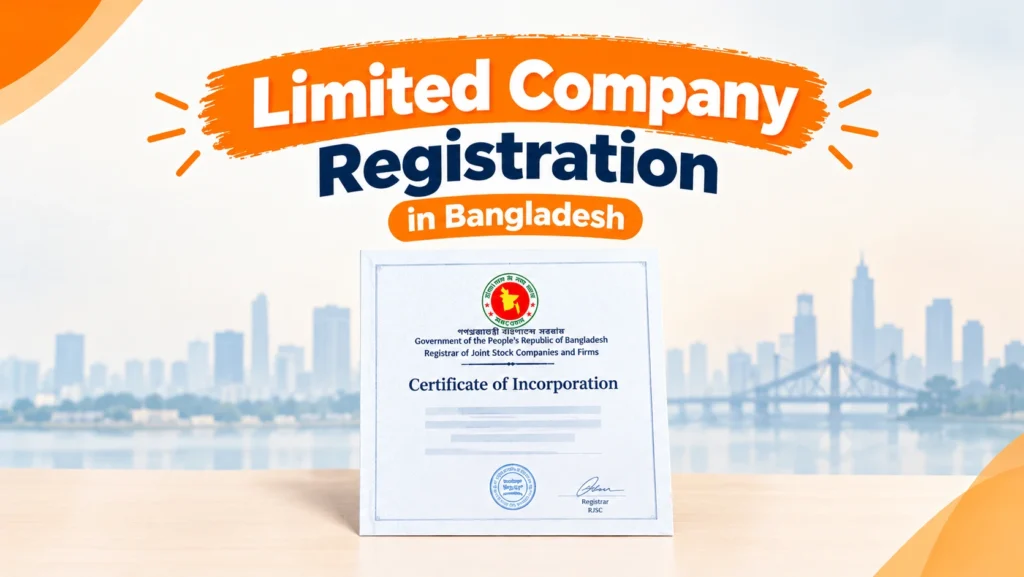
Starting a business with a partner, a sibling, or a few trusted friends? Sooner or later, someone will ask whether you should register a company. For most growing businesses in Bangladesh, Limited Company Registration is the smartest answer. It protects your personal assets, makes your business look credible to banks and clients, and opens the door to bigger contracts. The process is also less scary than it sounds. This guide explains the requirements, the real cost components, and every step of the RJSC process, so you can plan with confidence instead of guessing.
What Is a Limited Company in Bangladesh
A limited company is a separate legal entity. It can own property, sign contracts, and take loans in its own name. If the business struggles, the owners’ personal assets stay protected because each shareholder’s liability is limited to the unpaid value of their shares.
In Bangladesh, companies are formed under the Companies Act, 1994, and the Registrar of Joint Stock Companies and Firms (RJSC) handles every incorporation. A proprietorship cannot offer this protection. That is why serious growth plans almost always point toward a company.
Types of Limited Company You Can Register
Before you start, pick the structure that fits your plan. Here is how the three main options compare:
Company Type | Minimum Directors | Minimum Shareholders | Best For |
Private Limited Company | 2 | 2 (maximum 50) | Startups, SMEs, and family businesses |
Public Limited Company | 3 | 7 | Businesses planning to raise money from the public |
One Person Company (OPC) | 1, with a nominee | 1 | Solo founders |
Most entrepreneurs choose a private limited company. If you are launching alone, our One Person Company (OPC) registration page explains a lighter alternative.
Limited Company Registration Requirements
Meeting these basics before you start Limited Company Registration will save you days:
• At least two directors and two shareholders for a private company (the same people can hold both roles)
• A unique company name approved by RJSC through name clearance
• A registered office address in Bangladesh
• A Memorandum of Association (MOA) and Articles of Association (AOA)
• A clear decision on authorised capital and paid-up capital
Capital confuses many first-time founders, so let us keep it simple. Authorised capital is the maximum amount of shares your company is allowed to issue. Paid-up capital is the amount your shareholders have actually paid in.
For local private companies, the law does not set a minimum paid-up amount. Still, choose realistic figures. Banks, tender authorities, and foreign partners often judge your seriousness by your capital. Also remember that RJSC’s government fees grow with authorised capital, so setting it unrealistically high only makes registration more expensive.
Documents Required for Limited Company Registration
The exact documents for Limited Company Registration depend on whether your owners are local or foreign. Here is what RJSC typically expects:
Local Companies | Foreign-Owned Companies |
NID or passport copies of all directors and shareholders | Attested passport copies of all foreign directors and shareholders |
Recent passport-size photographs | Recent passport-size photographs |
Name clearance letter from RJSC | Name clearance letter from RJSC |
Proof of registered office (rent agreement or ownership paper) | Proof of registered office in Bangladesh |
Draft MOA and AOA | Draft MOA and AOA |
Signed consent and declaration forms | Signed consent and declaration forms |
Not applicable | Bank Encashment Certificate showing the remitted paid-up capital |
Not applicable | Attested or apostilled foreign documents, plus BIDA registration where required |
Keep every name, spelling, and address identical across all documents. A mismatch between a passport and an NID is one of the quickest ways to draw an objection from RJSC. If you are a foreign investor, our foreign company registration service covers the extra steps.
Step-by-Step Limited Company Registration Process
Here is the full process, from the first name search to the day you hold your certificate:
1. Choose your company name and apply for name clearance on the RJSC portal. Approval stays valid for one month, so be ready to move fast.
2. Decide your authorised capital, paid-up capital, directors, and shareholders.
3. Draft the MOA and AOA, covering your business objectives and internal rules.
4. Prepare consent forms and declarations for every director and subscriber.
5. For foreign-owned companies, open a bank account, remit the paid-up capital, and collect the Encashment Certificate.
6. Upload everything to the RJSC online portal and generate your payment slip.
7. Pay the registration fee, filing fee, and stamp duty through an authorised bank.
8. Submit physical documents if RJSC asks for them, and answer any objection quickly.
9. Receive your Certificate of Incorporation, certified MOA and AOA, and Form XII.
Notice the one-month window on the name clearance. Slow document drafting is the main reason founders lose their approved name and have to start over.
Limited Company Registration Cost in Bangladesh
There is no single price tag for Limited Company Registration, because the cost depends mostly on your authorised capital. This table shows how the expenses break down:
Cost Component | What to Expect |
Name clearance fee | A small per-name fee, usually a few hundred taka |
RJSC filing fee | About BDT 1,200 (six documents at BDT 200 each) |
RJSC registration fee | Minimal for small authorised capital, rising in bands as capital grows |
Stamp duty | Calculated on your authorised capital |
Professional service fee | Varies by consultant and by how complex your case is |
Post-registration items | Trade license, TIN, and BIN registration costs |
For a modest authorised capital, government-side expenses are usually far lower than most people expect. Recent examples put RJSC fees for a BDT 10 lakh authorised capital in the low thousands of taka. Costs climb noticeably if you choose a very large authorised capital. Fee schedules change over time, so confirm the current figures with RJSC before you finalise your budget.
How Long Does Limited Company Registration Take
After a complete submission, RJSC usually issues the Certificate of Incorporation within about five to seven working days. Foreign-owned companies take longer because of the banking steps and, sometimes, BIDA approval. Objections add more days.
A clean, consistent application is the best way to stay on the faster end. Double-check names, addresses, and capital figures before you press submit.
What to Do After You Get Your Certificate of Incorporation
Completing Limited Company Registration makes your company legal, but you cannot start trading yet. Your next steps look like this:
• Get a trade license from your city corporation or municipality
• Apply for a company TIN certificate from the National Board of Revenue
• Register for VAT and collect your BIN certificate
• Open a company bank account in the company’s name
• Apply for any sector-specific licenses your business needs
Registration is not a one-time event either. Each year, your company must hold an annual general meeting, file an annual return with RJSC, get its accounts audited, and submit tax and VAT returns on time. Missing these obligations leads to penalties and can even put your company’s standing at risk.
Common Mistakes That Delay Registration
• Choosing a name that is too close to an existing company
• Letting the one-month name clearance validity run out
• Entering director details that do not match passports or NIDs
• Setting authorised capital far higher than needed, then paying extra fees and stamp duty
• Forgetting the Encashment Certificate for foreign-owned companies
• Delaying the trade license, TIN, and BIN after incorporation
Limited Company vs Partnership: Which Should You Choose
If you are still undecided, here is the short version. A partnership firm is cheaper and faster to set up, with less paperwork. It works well when a small group of trusted partners wants a simple structure. A limited company costs more upfront, but it protects personal assets, attracts investors more easily, and builds long-term credibility. Curious about the simpler route? Read about partnership firm registration before you decide.
Why Choose Segunbagicha Consultancy
Handling Limited Company Registration on your own, from name clearance and MOA and AOA drafting to RJSC uploads and follow-ups, can eat up weeks. Segunbagicha Consultancy manages the whole journey for you, from the first name search to the final Certificate of Incorporation, and then helps you with the trade license, TIN, and BIN so you can start trading quickly.
Prefer reading in Bangla? Our কোম্পানি রেজিস্ট্রেশন গাইড covers the same ground in simple language. You can also browse our complete service list to see everything else we handle under one roof.
Get Expert Help Today
Whether you are about to register your first company or want a second opinion on your structure, reach out to Segunbagicha Consultancy today.
Address: Fareast Tower-2, 36 Topkhana Road (3rd Floor), Purana Paltan, Dhaka
Call: +880 1933-335313
WhatsApp: +880 1933-353506
Segunbagicha Consultancy — your trusted partner for business registration and compliance in Bangladesh.
Frequently Asked Questions
Q1: How many directors do I need for a private limited company?
You need at least two directors and two shareholders. The same people can fill both roles.
Q2: Is there a minimum paid-up capital?
For local private companies, the law sets no statutory minimum. Foreign-owned companies must remit their capital through a bank, and practical expectations apply, so plan realistic figures either way.
Q3: How long does the whole process take?
Roughly five to seven working days after a complete submission. Foreign-owned companies usually take longer.
Q4: Can a foreigner own 100% of a company in Bangladesh?
In most sectors, yes, subject to the rules that apply to your industry. Check the sector requirements before you commit.
Q5: What is the difference between authorised and paid-up capital?
Authorised capital is the most your company can issue. Paid-up capital is what shareholders have actually paid in. RJSC’s fees depend on authorised capital.
Q6: Do I still need a trade license after registration?
Yes. The Certificate of Incorporation does not replace a trade license, so apply for one right away.
Q7: Can I register a company online?
The process runs mainly through the RJSC online portal, although RJSC may ask for some physical documents.
Q8: What if my name clearance expires before I finish?
You will need to apply for name clearance again, and the name may no longer be available. That is why it pays to prepare your documents first.
Final Thoughts
Registering a company feels big, but it becomes manageable once you break it into steps. Choose the right structure, prepare consistent documents, respect the one-month name clearance window, and plan your capital sensibly. If you would rather hand the paperwork to people who do this every day, get in touch with Segunbagicha Consultancy today.